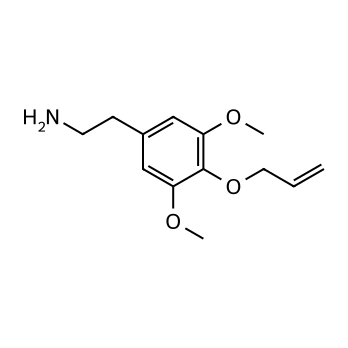
Allylescaline is a psychedelic substance in the phenethylamine and scaline classes, and is structurally related to mescaline and escaline. Otakar Leminger reported the compound in 1972, and Alexander Shulgin later discussed it in his 1991 book PiHKAL. It appeared as a novel designer drug in 2013. Allylescaline remains relatively uncommon, with little documented history of human use.
Allylescaline molecular structure diagram from the DrugsPRO substance library.
Also known as: Al, Allylmescaline
Classification
Chemical: Phenethylamine
Psychoactive: Psychedelic
Tag: Hallucinogen
Tag: Research-Chemical
Tag: Scaline
Tag: Substituted phenethylamine
Effects
Spontaneous Tactile Sensations
Stimulation
Nausea
Pupil Dilation
Physical Euphoria
Mentalphysical Stimulation
Emotion Enhancement
Thought Acceleration
Novelty Enhancement
Time Distortion
Analysis Enhancement
Personal Bias Suppression
Tactile Enhancement
Bodily Control Enhancement
Hallucinations
Drifting
Tracers
After Images
Routes of Administration
Oral
Dosage
Heavy: 60 mg
Light: 20 – 30 mg
Common: 30 – 40 mg
Strong: 40 – 60 mg
Threshold: 15-20 mg
Duration
Onset: 0.75-4 h
Peak: 1-1.25 h
After Effects: 1-16 h
Harm Reduction
Check interactions before mixing substances, pay attention to dose spacing and hydration, and treat all dosage guidance as approximate rather than guaranteed safe.
Sources
Substance data is aggregated from the following public harm-reduction and reference sources.
This static page is intended as a readable non-JS and prerender-friendly library export.
Get the full DrugsPRO experience
Open the interactive DrugsPRO app for search, saved items, interactions, and deeper harm reduction tools.
Get the PRO test kit. The simple, quick and reliable drug checking test kit. Visit https://protestkit.eu
Allylescaline - DrugsPRO substance guide
Allylescaline: Allylescaline is a psychedelic substance in the phenethylamine and scaline classes, and is structurally related to mescaline and escaline. Otakar Leminger reported the compound in 1972, and Alexander Shulgin later discussed it in his 1991 book PiHKAL. It appeared as a novel designer d