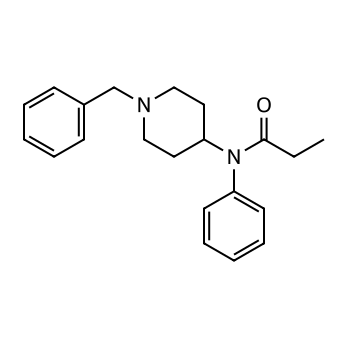
Benzylfentanyl (R-4129) is a fentanyl analog. It was temporarily placed in the US Schedule I by emergency scheduling in 1985 due to concerns about its potential for abuse as a designer drug, but this placement was allowed to expire and benzylfentanyl was formally removed from controlled substance listing in 2010, after the DEA's testing determined it to be "essentially inactive" as an opioid. It was added as a List I precursor instead in 2020 after it was determined that it was being used in fentanyl manufacture, which was previously thought to be beyond the technical capability of illicit labs. Benzylfentanyl has a Ki of 213 nM at the mu opioid receptor, binding around 1/200 as strong as fentanyl itself, though it is still slightly more potent than codeine.
Bencilfentanilo molecular structure diagram from the DrugsPRO substance library.
Classification
Chemical: Anilidopiperidine
Chemical: Opioid
Psychoactive: Depressant
Effects
Sedation
Motor Impairment
Respiratory Depression
Constipation
Pupil Constriction
Itchiness
Reduced Anxiety
Euphoria
Anxiety Suppression
Mood Lift
Dulled Perception
Decreased Libido
Double Vision
Dehydration
Appetite Suppression
Routes of Administration
No route information available yet.
Harm Reduction
Check interactions before mixing substances, pay attention to dose spacing and hydration, and treat all dosage guidance as approximate rather than guaranteed safe.
Sources
Substance data is aggregated from the following public harm-reduction and reference sources.
This static page is intended as a readable non-JS and prerender-friendly library export.
Get the full DrugsPRO experience
Open the interactive DrugsPRO app for search, saved items, interactions, and deeper harm reduction tools.
Get the PRO test kit. The simple, quick and reliable drug checking test kit. Visit https://protestkit.eu
Benzylfentanyl - Guía de sustancias de DrugsPRO
Benzylfentanyl: Benzylfentanyl (R-4129) is a fentanyl analog. It was temporarily placed in the US Schedule I by emergency scheduling in 1985 due to concerns about its potential for abuse as a designer drug, but this placement was allowed to expire and benzylfentanyl was formally removed from control