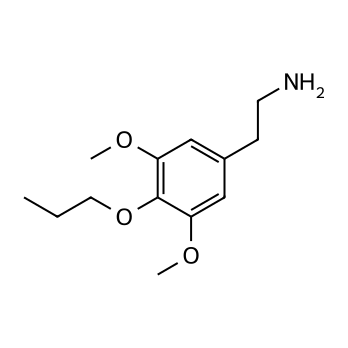
Proscaline is a lesser-known psychedelic of the substituted phenethylamine class, structurally related to mescaline as its 4-propyloxy analog. Its synthesis was first published by David E. Nichols in 1977, and it was later evaluated by Alexander Shulgin, who estimated its potency at roughly five times that of mescaline. Shulgin documented his findings in the 1991 book PiHKAL. It belongs to a series of mescaline analogs including escaline and allylescaline, and appeared on the research chemical market in the 2010s.
Proskalina molecular structure diagram from the DrugsPRO substance library.
Also known as: P, 4-propoxy-3,5-dmpea
Classification
Chemical: Phenethylamine
Psychoactive: Psychedelic
Tag: Hallucinogen
Tag: Research-Chemical
Tag: Scaline
Tag: Substituted phenethylamine
Effects
Pupil Dilation
Temperature Regulation Suppression
Stimulation
Muscle Tension
Tremors
Mentalphysical Stimulation
Euphoria
Empathy Enhancement
Irritability
Analysis Enhancement
Confusion
Sociability Enhancement
Appetite Suppression
Tactile Enhancement
Color Enhancement
Brightened Color
Closedopen Eye Visuals
Enhanced Tactile Sensation
Routes of Administration
Oral
Dosage
Heavy: 60 mg
Light: 10 – 30 mg
Common: 30 – 40 mg
Strong: 40 – 60 mg
Threshold: 10 mg
Duration
Onset: 0.5-1 h
After Effects: 3-5 h
Harm Reduction
Check interactions before mixing substances, pay attention to dose spacing and hydration, and treat all dosage guidance as approximate rather than guaranteed safe.
Sources
Substance data is aggregated from the following public harm-reduction and reference sources.
This static page is intended as a readable non-JS and prerender-friendly library export.
Get the full DrugsPRO experience
Open the interactive DrugsPRO app for search, saved items, interactions, and deeper harm reduction tools.
Get the PRO test kit. The simple, quick and reliable drug checking test kit. Visit https://protestkit.eu
Proscaline - przewodnik po substancji DrugsPRO
Proscaline: Proscaline is a lesser-known psychedelic of the substituted phenethylamine class, structurally related to mescaline as its 4-propyloxy analog. Its synthesis was first published by David E. Nichols in 1977, and it was later evaluated by Alexander Shulgin, who estimated its potency at roug