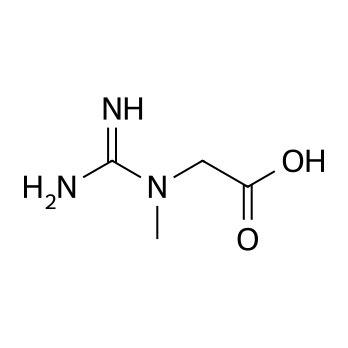
Creatine (and its derivatives hydrochloride, malate, nitrate, et al.) is an amino acid with nootropic effects that occurs naturally within the body of vertebrates and in some foods such as meat, eggs, and fish. It was identified in 1832 when Michel Eugène Chevreul isolated it from the basified water-extract of skeletal muscle. He later named the crystallized precipitate after the Greek word for meat, κρέας (kreas). Early analysis showed that human blood is approximately 1% creatine.
Kreatín molecular structure diagram from the DrugsPRO substance library.
Also known as: Metylguanidooctová kyselina, N-karbamimidoyl-n-methylglycín
Classification
Chemical: Medicine
Psychoactive: Nootropic
Tag: Adulterant
Tag: Supplement
Effects
No data available for this section yet.
Routes of Administration
Oral
Dosage
Threshold: 0.25 g
Heavy: 20 g
Common: 5-10 g
Light: 1-5 g
Strong: 10-20 g
Duration
Onset: 0.5-1.5 h
Harm Reduction
Check interactions before mixing substances, pay attention to dose spacing and hydration, and treat all dosage guidance as approximate rather than guaranteed safe.
Sources
Substance data is aggregated from the following public harm-reduction and reference sources.
This static page is intended as a readable non-JS and prerender-friendly library export.
Get the full DrugsPRO experience
Open the interactive DrugsPRO app for search, saved items, interactions, and deeper harm reduction tools.
Get the PRO test kit. The simple, quick and reliable drug checking test kit. Visit https://protestkit.eu
Creatine - DrugsPRO sprievodca látky
Creatine: Creatine (and its derivatives hydrochloride, malate, nitrate, et al.) is an amino acid with nootropic effects that occurs naturally within the body of vertebrates and in some foods such as meat, eggs, and fish. It was identified in 1832 when Michel Eugène Chevreul isolated it from the basi