


Drug test kits – Drug purity testing kits
The highest level of analysis for your substance
The analysis lasts 4-10 days and costs €99. After payment you will receive instructions and the code needed to submit a sample.
When ordering the lab analysis for any other item purchased in our store we offer completely free delivery.
Safe
The analysis is anonymous, performed in a 100% legał laboratory.
Precise
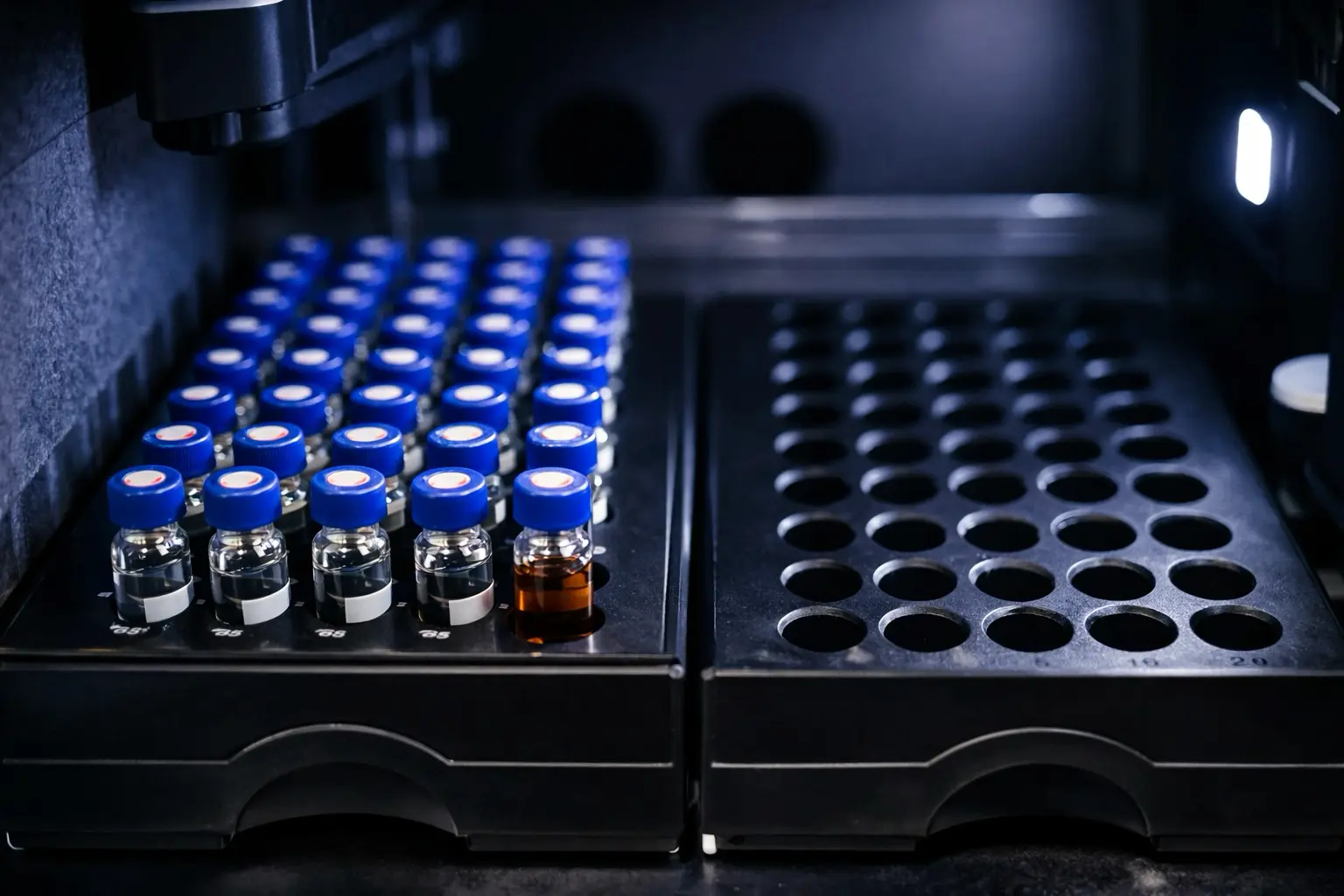
Our experts use methods such as NMR, GC-MS, HPLC and FTIR.
Fast
You will receive results in 4-10 days after sample is delivered to the lab.
How does it work?
The analysis lasts 4-10 days and costs €99. After payment you will receive instructions and the code needed to submit a sample.
BUY NOWFAQ
Everything you might want to know about laboratory analysis.
What can be tested?
- LSD
- Tryptamines (DMT, 4-AcO, DMT, DET, etc.)
- Phenethylamines (2C-B,
- MDMA, MDA, etc.)
- Amphetamines and derivatives (speed, methamphetamine, etc.)
- Cocaine and additives
- Opiates (heroin, oxycodone, morphine, etc.)
- Cathinones (2,3,4-MMC, MDPV, etc.)
- Various small molecules
- Some medications
- Many others
Don't see your substance here? Write to us!
What won't we check?
- Explosives
- Biological samples (urine, blood)
- Biologically hazardous substances (viruses, bacteria)
- Radioactive substances
- Solvents
- Hormones dissolved in oil
- Foods
- Liquids
- Peptides (most types)
- Reaction mixtures with strong acids/bases
- Tablets with an active ingredient < 5 mg (e.g., Xanax)
- Herbs, hashish, or other cannabis products
Where to send the sample?
The laboratory is located in Barcelona, Spain. The experts conducting the analyses have decades of experience in analytical chemistry and specialize in testing for psychoactive substances.
Is the service safe?
Absolutely. The laboratory performing the analysis is 100% legally operating, and by submitting your sample, you remain anonymous; at no stage are you obligated to disclose your personal information.
What are our research methods?
The testing we offer is both qualitative (identification) and quantitative (purity). It is performed using high-field NMR*, GC-MS*, HPLC-DAD, and FTIR, in addition to detection and high-probability identification, and sample quantification (e.g., % purity, mg/ml, mg/tablet, µg/blotter, etc.).
* NMR is sometimes used when reference standards are not available for HPLC-DAD quantification or to identify unknown peaks, and GC-MS is also used to identify minor impurities and unknown peaks.
FTIR Spectroscopy
A technique used to obtain an infrared spectrum of a sample to identify its molecular structure and chemical properties. It uses libraries to rapidly identify components, and the spectra can also be interpreted by a skilled technician, who can obtain information about the functional groups present in the molecule.
HPLC-DAD
High-performance liquid chromatography with diode array detection. An analytical technique that separates chemical mixtures and analyzes them using UV-visible absorption. It allows for the identification and quantification of compounds based on their retention time and UV-visible spectra compared to reference standards.
NMR Spectroscopy
Nuclear magnetic resonance uses a strong magnetic field (400 MHz) and radio waves to obtain detailed information about molecular structure, identity, and dynamics. It allows us to identify and quantify substances and impurities with exceptional accuracy. GC-MS
GC-MS
Gas chromatography-mass spectrometry is an analytical technique that combines gas chromatography (GC), which separates chemical compounds, with mass spectrometry (MS), which ionizes and fragments chemical compounds for identification by measuring their mass-to-charge ratio. This creates unique fingerprints (mass spectra) for qualitative analysis in our substance control project.