


What the Ehrlich reagent shows, and what it does not
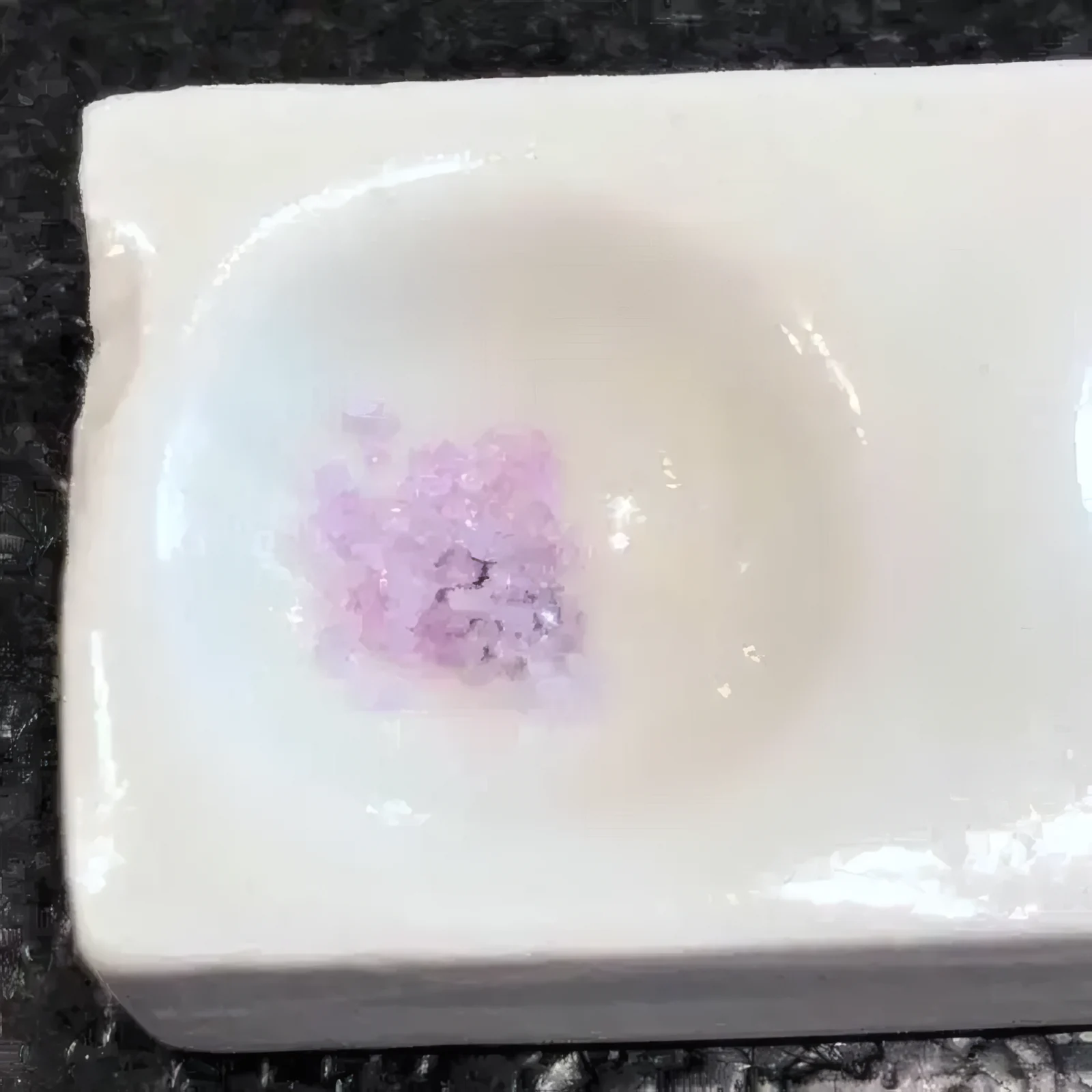
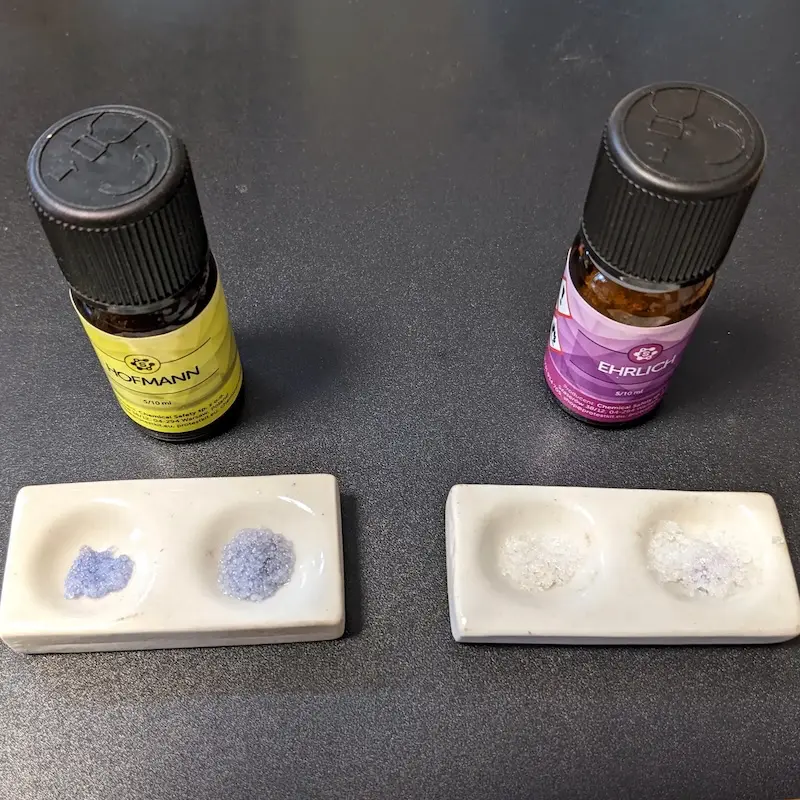
The Ehrlich reagent detects an indole. Not LSD, not DMT, not psilocin specifically, but the indole ring those compounds share, which it reports by turning purple. Everything that confuses people about Ehrlich follows from that one fact: a purple result is a statement about a chemical family, and melatonin from a pharmacy gives the same purple as a tab of acid. That is exactly what Hofmann is for, and it is why the two are sold together: run the pair and a deep blue separates a lysergamide from every other indole in minutes.

Why a blank result can matter more than a purple one
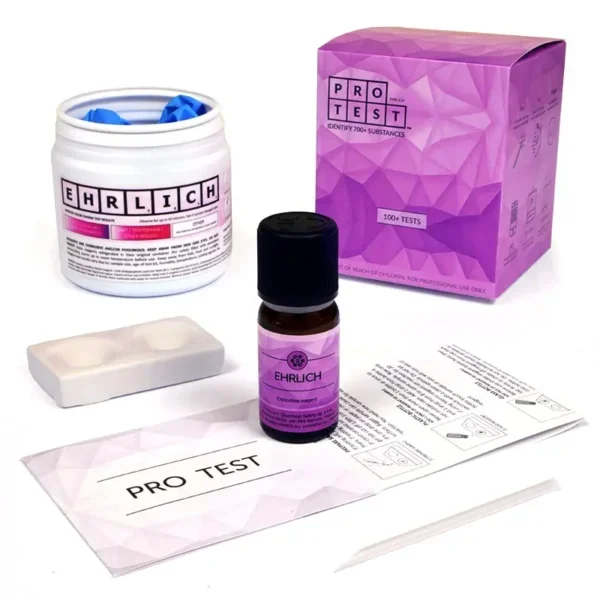
Ehrlich answers one question: is there an indole here. On blotter that question is worth more than it sounds, because a tab carrying a psychoactive dose is either a lysergamide, which is an indole, or one of the NBOMe, DOx and NBOH compounds, which are not.
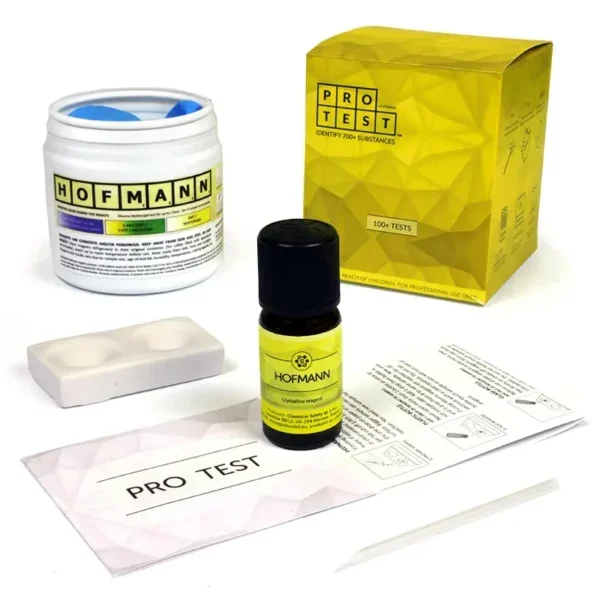
Purple says you are in the right family, and Hofmann is the next step: deep blue for a lysergamide, yellow-green for another indole.
A blank is the result that suggests an adulterant. It does not tell you yet what is in the sample, only that whatever is there is not an indole, and on a tab sold as acid that leaves a short list of compounds. Marquis and Mecke reagents can help narrow down the list of likely phenethylamines.
NBOMe and DOx on blotter · Ehrlich instructions
When no reaction is a good result
A prodrug blotter such as 1P-LSD, 1cP-LSD or 1V-LSD reacts slowly or not at all until the sample is activated with a drop of alkaline reagent. 1S-LSD similarly is not expected to react, because both Ehrlich and Hofmann need it to first change into LSD. And a very small sample, an eighth of a tab, can give a reaction so faint it reads as nothing.
The LSD prodrugs compared · The activation method
A purple that came from tryptamine
One interesting sample published by DrugsData.org was described as containing 1P-LSD, but produced a strong purple colour change with the Ehrlich reagent. On further inquiry the analytical lab also found tryptamine. Whether it was added on purpose or not, that clearly indicates how easy it is to misinterpret an Ehrlich test result, and it is why we pair Ehrlich with Hofmann as a matter of course.
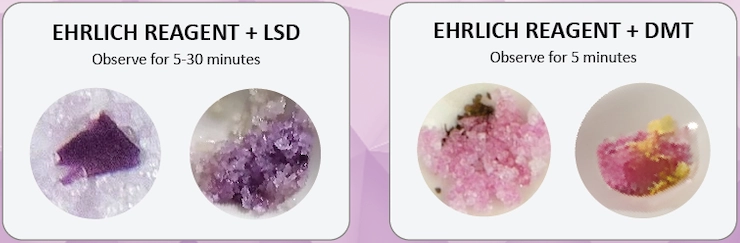
Ehrlich reagent: what it shows and what it misses: common questions
Does Ehrlich prove I have LSD?
No. It indicates an indole is present. Hofmann separates lysergamides from other indoles by turning deep blue rather than yellow-green.
Will melatonin turn Ehrlich purple?
Yes. So will tryptamine, which is what made the adulteration case above work.
Does Ehrlich detect NBOMe?
No, and that is how it is used. NBOMe is not an indole and produces no reaction.
My tab did not react at all.
Either not a lysergamide, or a prodrug needing activation, or 1S-LSD, or too small a sample. Do not assume the reassuring option.
No test result can tell you a substance is safe. No substance is 100% safe.This article is published for harm reduction purposes. It does not encourage the use of psychoactive substances and does not replace medical advice.