


How to test THC / CBD?
How to test THC / CBD and other cannabinoids: if you intend to use a psychoactive substance or hemp first you need a test kit to check it’s purity and quantity. Cannabis products such as weed, hash, oil, cakes can not be identified by appearance. Check your sample with a single or multi-use Cannabinoids test kit.
Cannabis tester

Recommended CBD / THC testing kits
Recommended multi-use CBD / THC Reagent Test Kit includes reagents Cannabis (4-AP), Zimmermann and a magnifying glass. Reagents help rule out presence of synthethic cannabinoids and estimate CBD and THC quantity. To discover full cannabinoids profile and estimate THC and CBD quantity % pair reagents with the TLC Cannabinoids Test Kit. To detect fentanyl use the fent strips.
STEP ONE How to detect synthetic cannabinoids, CBD and THC?
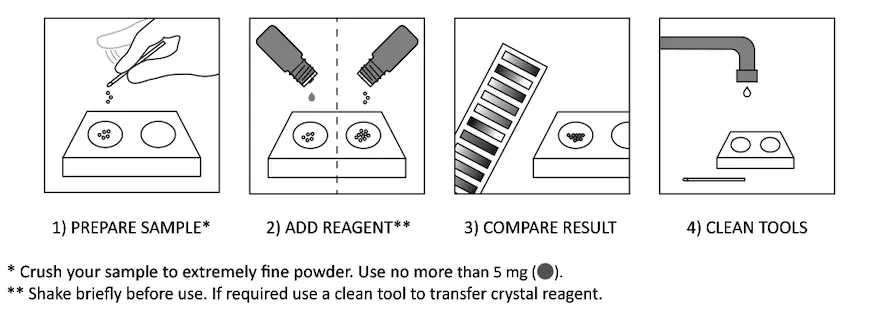
How to use reagent tests?
Magnify or zoom in
If you are testing flowers, inspect the bud for the white or brownish “hairs” (pistils) and the crystals (trichomes) that are typical of cannabis. A magnifying glass or a phone camera zoom is enough.
Note the ratio of amber to white trichomes: it suggests how much of the THC has already oxidised to CBN.
TL;DR: Below is an image with a quick cheat sheet how to use the CBD / THC Test Kit and further down you can check out more detailed guide how to test cannabis products. Use the CBD / THC reagent test chart to see how to use Cannabis reagent and Zimmermann. Check the expected results.
CBD / THC test results chart:
| TEST | CBD | THC |
| CANNABIS (4-AP) | Purple | Blue |
| ZIMMERMANN | Purple | No instant vivid color change |
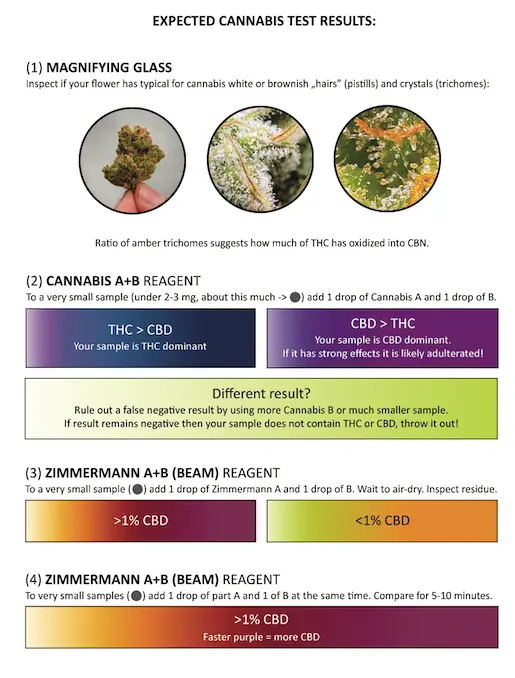
CBD / THC reagent test chart
What are CBD / THC test kit reagents used for?
| SAMPLE | RECOMMENDED CBD / THC REAGENT TESTS |
| FLOWERS (MARIJUANA, WEED) EXTRACTS (HASH, OIL), FOOD |
|
Reagent tests indicate presence of a substance, therefore can either help confirm presence of the expected compound or help rule out certain cuts.
- Cannabis (4-AP) – main test for THC / CBD, helps rule out synthetic cannabinoids
- Zimmermann / Beam – main test for cathinones and benzodiazepines in geneal, detects also CBD
- Single use cannabis test kit includes Cannabis reagent
- Multi use CBD / THC reagent test kit includes reagents Cannabis and Zimmermann
Cannabis reagent (4-AP) indicates if sample contains mostly THC (blue color change), mostly CBD (pink or purple color change) or no cannabinoids at all. Confirming THC dominant sample helps rule out presence of synthethic cannabinoids (source: saferparty.ch research partnership). Zimmermann reagent helps detect CBD and compare CBD quantity between samples.
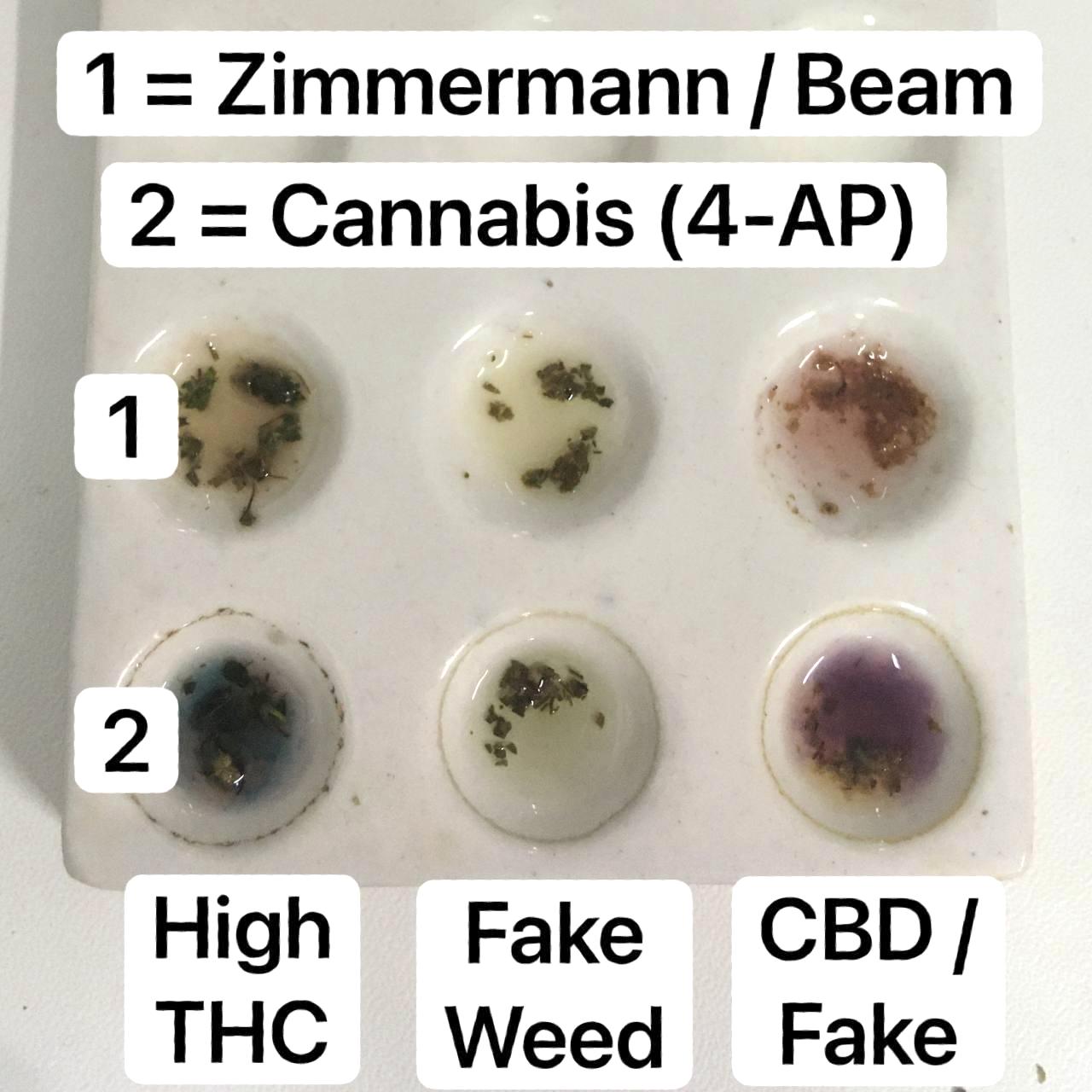
CBD / THC test kit results
How to test CBD quantity?
How to test THC quantity?
Questions?
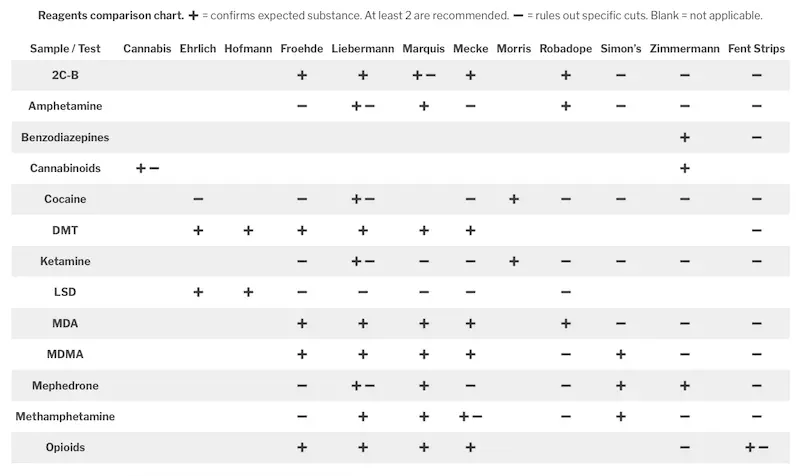
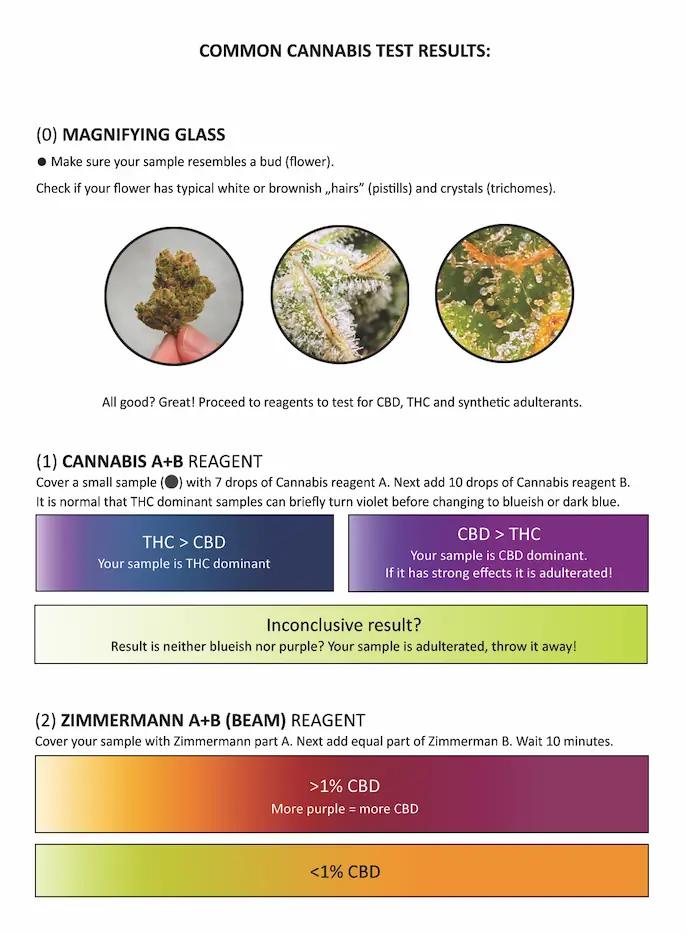 Expected CBD/THC test kit results:
STEP TWO How to test CBD and THC quantity %?
To discover all cannabinoids and estimate quantity pair reagent tests with a TLC (Thin Layer Chromatography) Purity Test Kit. TLC purity tests alone don’t identify substances and are best paired with at least 1-2 reagent tests. Thin Layer Chromatography is one of classic substance analysis methods. It works by separating different compounds depending on their solubility in chosen TLC testing liquid (eluent). To precisly estimate THC and CBD quantity pair a reagent test kit with the TLC Cannabinois Test Kit.
How to test quality of CBD oil, THC oil, flowers and other cannabis products?
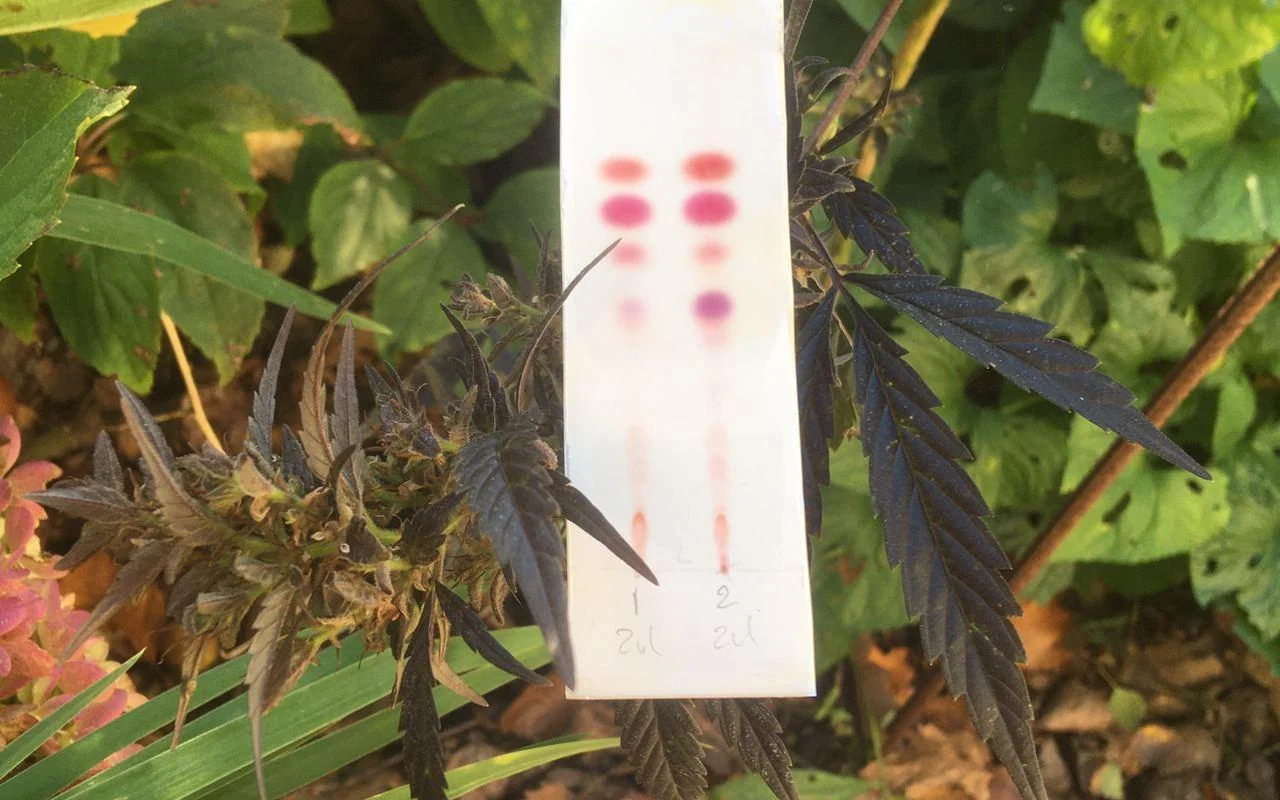
Qualitative TLC:
TLC test works by separating substances present in a sample, each detected spot indicates a different substance.
- Kit comes with a calibrated ruler which indicates where to look for specific cannabinoids such as CBD, THC, THCV, CBC, CBG, CBN.
- You can use an already confirmed sample for reference – if both compounds show up at the same height on the TLC “card” that indicates they can be the same substance..
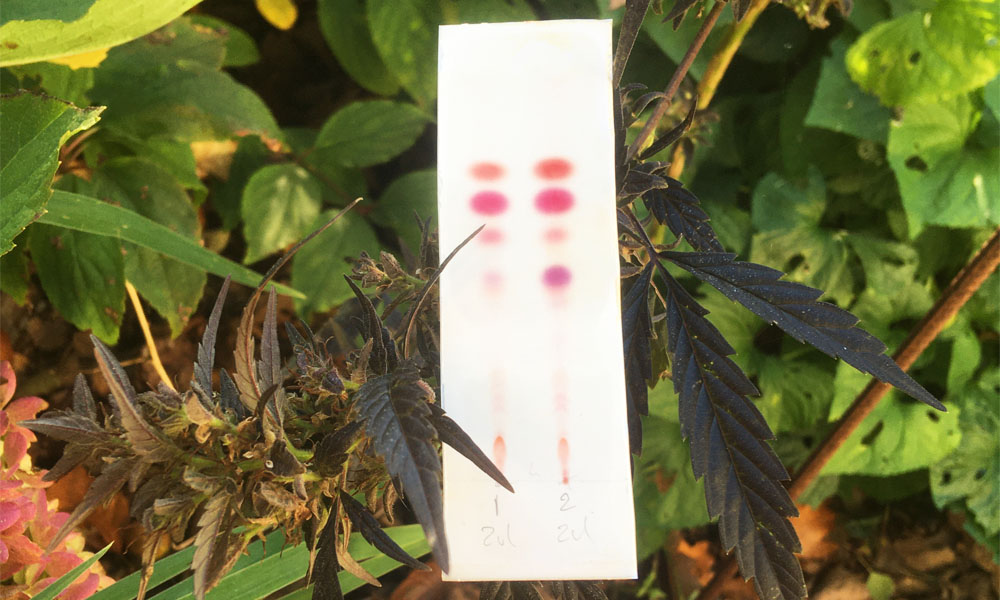
TLC Cannabinoid Quantity Test results
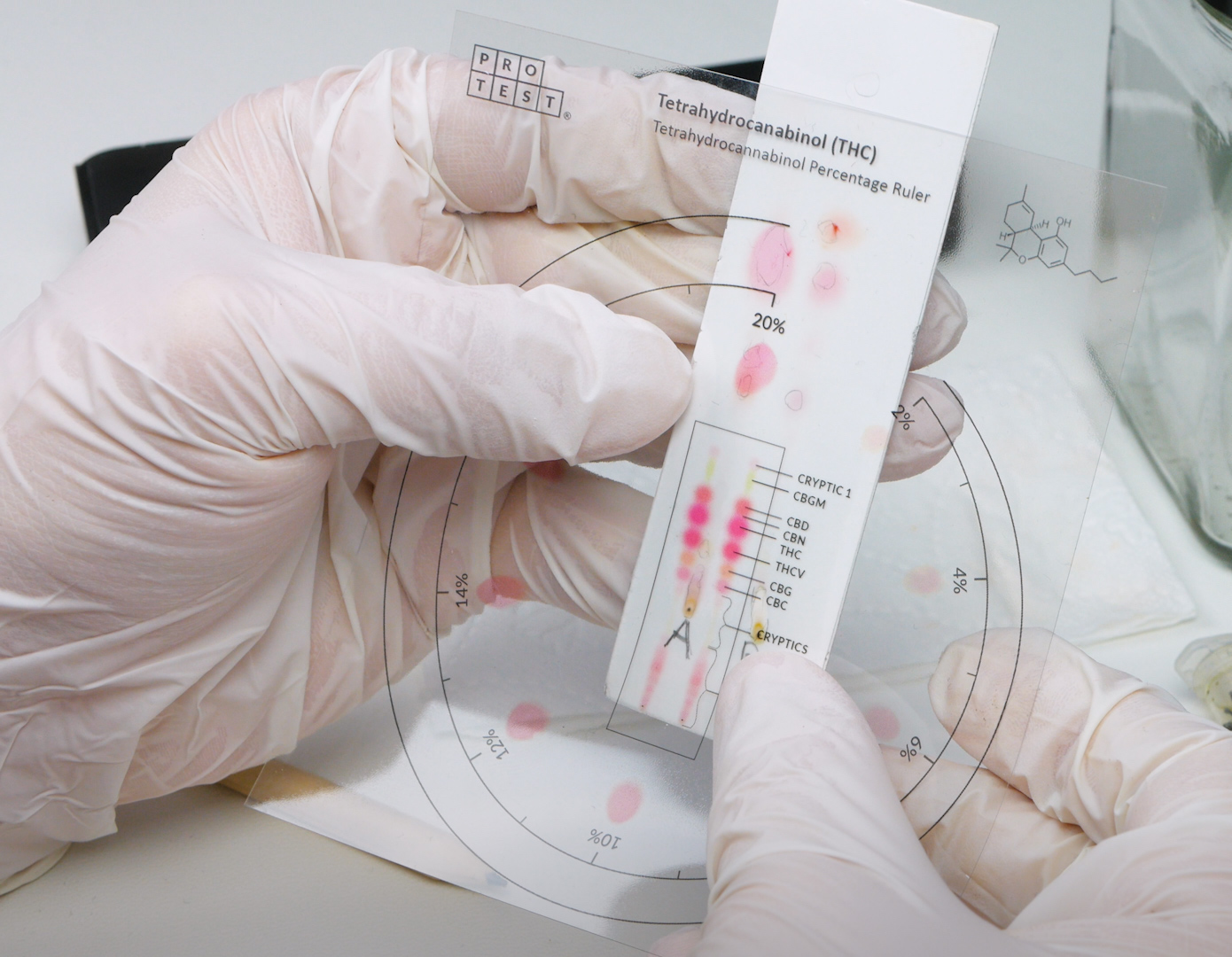
TLC THC Quantity Test scale
How to estimate THC and CBD quantity %?
Semi-quantitative TLC:
TLC helps estimate quantity (quantity). The bigger the size of the detected spot, the bigger the amount of measured substance. Note that different substances need different calibrated rulers and often different testing liquids (eluents).
- Use a calibrated quantity % scale to estimate result with +-1% accuracy
- One spot indicates a pure substance. If your sample fully dissolved in testing liquid and only one spot was detected on TLC then your substance is pure. Trace amounts of impurities might not be detected, do not rely on TLC for fentanyl testing – get also fentanyl test strips
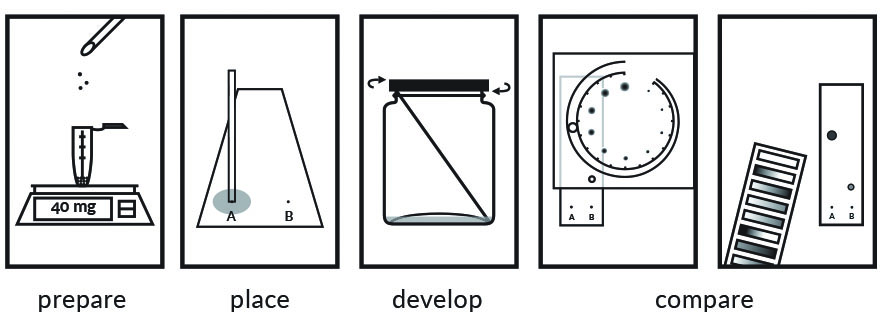
How to use TLC Cannabinoid Quantity test?
Questions?

How to test weed for fentanyl?
Use fentanyl test strips (a fentanyl test kit)

METHOD 1
Add small sample to a plastic baggie. If testing a pill crush it in the baggy and dump out the powder. Then add 10 drops of water into the baggie and mix well. Dip the test strip no higher than the thick line. Wait 15 seconds. Put the strip away and check in 5 minutes.
METHOD 2
Mix sample in the ratio of 1 mg of sample per 2 ml of water. Dip the test strip no higher than the thick line. Wait 15 seconds. Put the strip away and check in 5 minutes.
COMPARE RESULTS
1 line = fentanyl, 2 lines = no fentanyl. Faint lines also count. Ignore fentanyl tester results after 5 minutes.
To detect all ingredients and estimate their amount pair reagents with a TLC purity test kit.
A positive or negative test result does not indicate if a substance is safe. No substance is 100% safe.
How to read the result
A positive result is a colour change resembling one shown in the instructions. It does NOT indicate quantity, purity or safety. Adulterants often do not react at all – try to detect them using different reagents. A negative result is a colour change that differs from the instructions: your sample is adulterated, discard it.
Harm reduction
There is no such thing as fully safe drug use, but harm reduction rules can help make psychoactive substances safer. Always do an “allergy test” – with a substance you do not know yet, start with 1/3 of a dose or less. Always use the smallest dose needed for the effect you want. Never share equipment, and do not use dirty objects such as banknotes (infection risk). Do not redose, at least not for 2-3 hours. Avoid mixing psychoactive substances.
No test result can tell you a substance is safe. No substance is 100% safe.This article is published for harm reduction purposes. It does not encourage the use of psychoactive substances and does not replace medical advice.