


Delta-8, HHC and the semi-legal cannabinoids
Delta-8-THC, HHC, THCP and H4CBD are semi-synthetic cannabinoids: made in a lab from hemp CBD rather than grown, and sold in the space between what the law names and what it does not. They reach the same receptor as delta-9-THC and sit close enough to it chemically that the 4-AP reagent reacts to all of them, so a correct cannabinoid reaction confirms you have a cannabinoid and tells you nothing about which one you have.
They are also new, which is the harder half. There is little published pharmacology for most of them, the conversion from CBD leaves by-products that nobody routinely looks for, and no reagent separates one cannabinoid from another. That is a testing card's job.
The synthetic cannabinoids are the opposite case: they stay blank on 4-AP, and on material sold as cannabis that blank is itself the finding. It is an indirect detection, the same way a blank Ehrlich on a tab sold as acid points to an NBOMe.

Which synthetic cannabinoids are on the market
Which ones actually show up
Delta-8 is the one that shows up. Of 187 published cannabis samples it appeared in 38, against CBD in 90, CBN in 52 and CBG in 41. CBN in particular forms as THC degrades, so a high CBN figure usually points to an old or badly stored sample rather than an added ingredient.
HHC appeared six times, and THCP and H4CBD not at all. That is a gap in what has been submitted rather than a statement about what is on sale: these are recent products, and a laboratory reports what it was asked to look for.
The table below gives the count for each compound across those 187 samples.
| Detected | Samples |
|---|---|
| CBD | 90 |
| CBN | 52 |
| CBG | 41 |
| Delta-8-THC | 38 |
| HHC | 6 |
| THCP | 0 |
| H4CBD | 0 |
What is in cannabis and CBD products · Browse the alerts database
A testing card separates what a reagent cannot
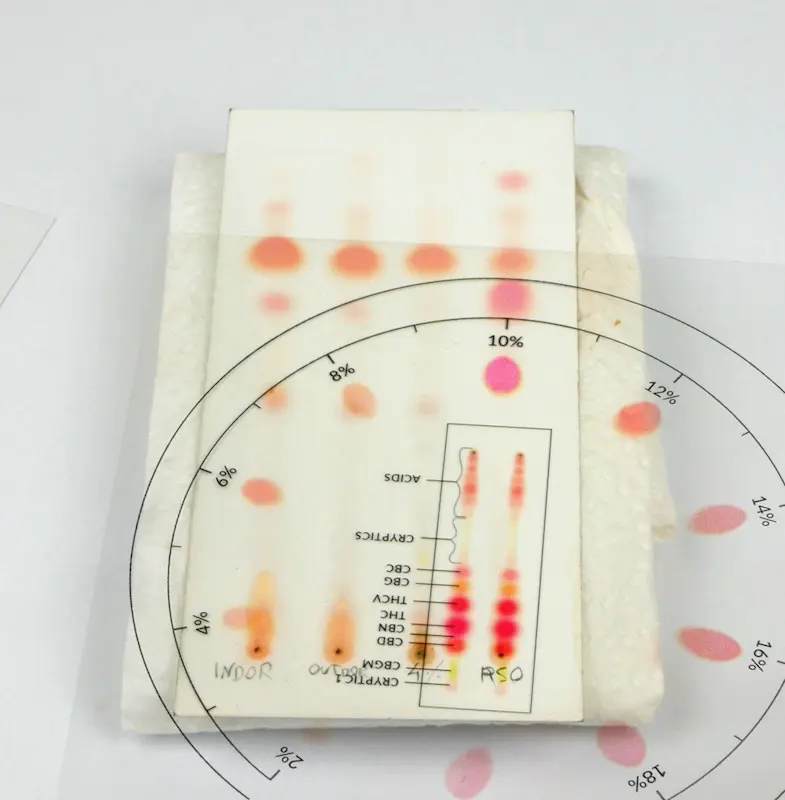
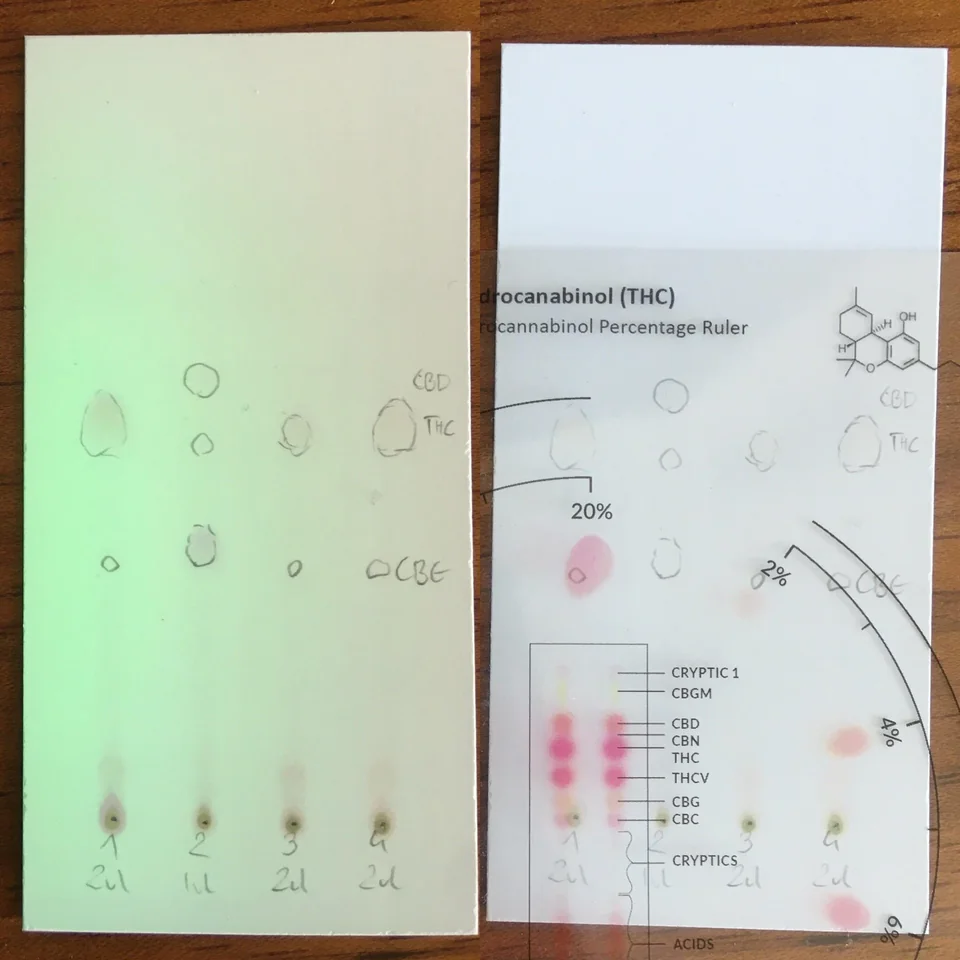
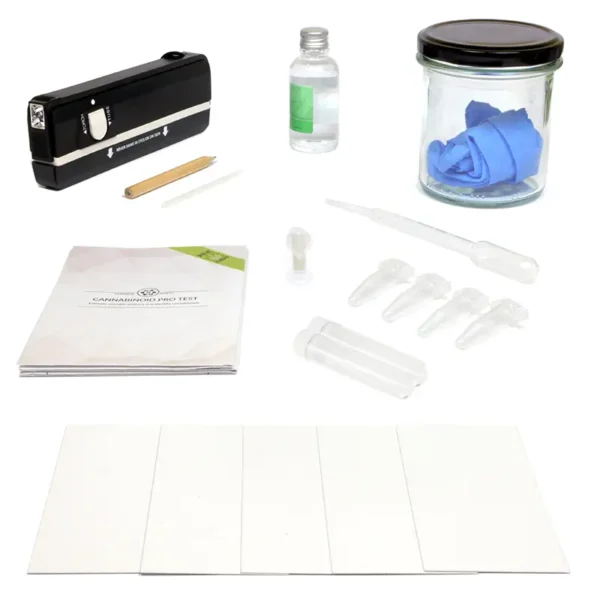
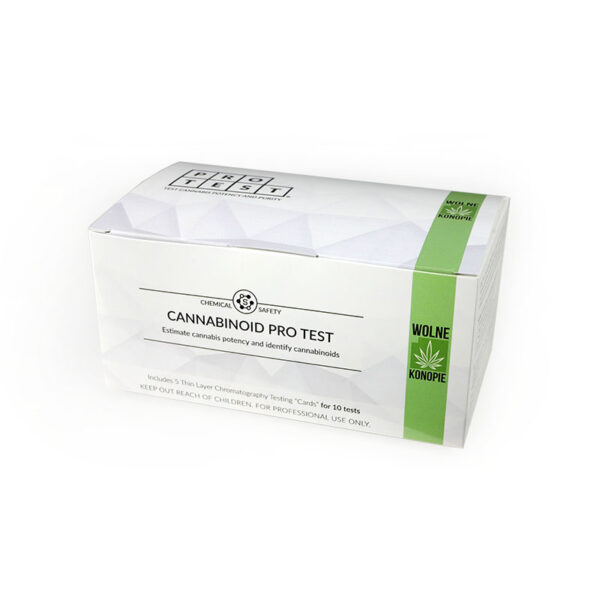
TLC shows each cannabinoid as its own spot at its own height, so a sample sold as high-THC flower that is mostly CBD and CBN is visible in one look, and so is delta-8 in a product sold as delta-9. Against a reference it also gives you a percentage, which is what the cannabinoid quantity kit is built for.
How a TLC test works · What is HHC
Delta-8, HHC and the semi-legal cannabinoids: common questions
Will the 4-AP reagent tell delta-8 from delta-9?
No. Both are cannabinoids and both react. Use a testing card.
Is HHC detected by the reagent?
It reacts as a cannabinoid. Identifying it specifically needs chromatography.
Why is there CBN in my flower?
CBN forms as THC degrades, so it usually indicates age or poor storage.
Are these safer than synthetic cannabinoids?
They are a different class entirely. The synthetics are full CB1 agonists, and the harm reported with them runs to seizures and acute kidney injury far more often than to cardiac events.
No test result can tell you a substance is safe. No substance is 100% safe.This article is published for harm reduction purposes. It does not encourage the use of psychoactive substances and does not replace medical advice.