


How to test drug purity?
How to test drug purity: a reagent tells you whether a substance is present. It cannot tell you how much of the sample is that substance, or what makes up the rest. For that you need a purity test, and for a dose figure a quantity test. To detect fentanyl or its analogues we recommend fentanyl test strips.
This guide covers purity and quantity. If you first need to confirm that your sample is what it was sold as, start with How to test drug presence?
A positive or negative test result does not tell you a sample is safe. No substance is 100% safe. Reagents show what is present, not how much of it is there. Around 90% of adulterants react with one reagent in three and 95% with one in five, so use several reagent tests rather than one, and add a purity test when you need the full composition.
Presence, purity and quantity are three different questions
| QUESTION | TEST |
| Is the expected substance present? | Reagent tests |
| What else is in the sample, and roughly how much? | TLC purity test kits |
| How strong is one dose? | Quantity tests |
| Everything, to laboratory accuracy | Full lab analysis |
Most harm comes from the second and third questions, not the first. A sample can contain exactly the substance you expected and still be dangerous because the dose is three times what you assumed.
How thin layer chromatography works
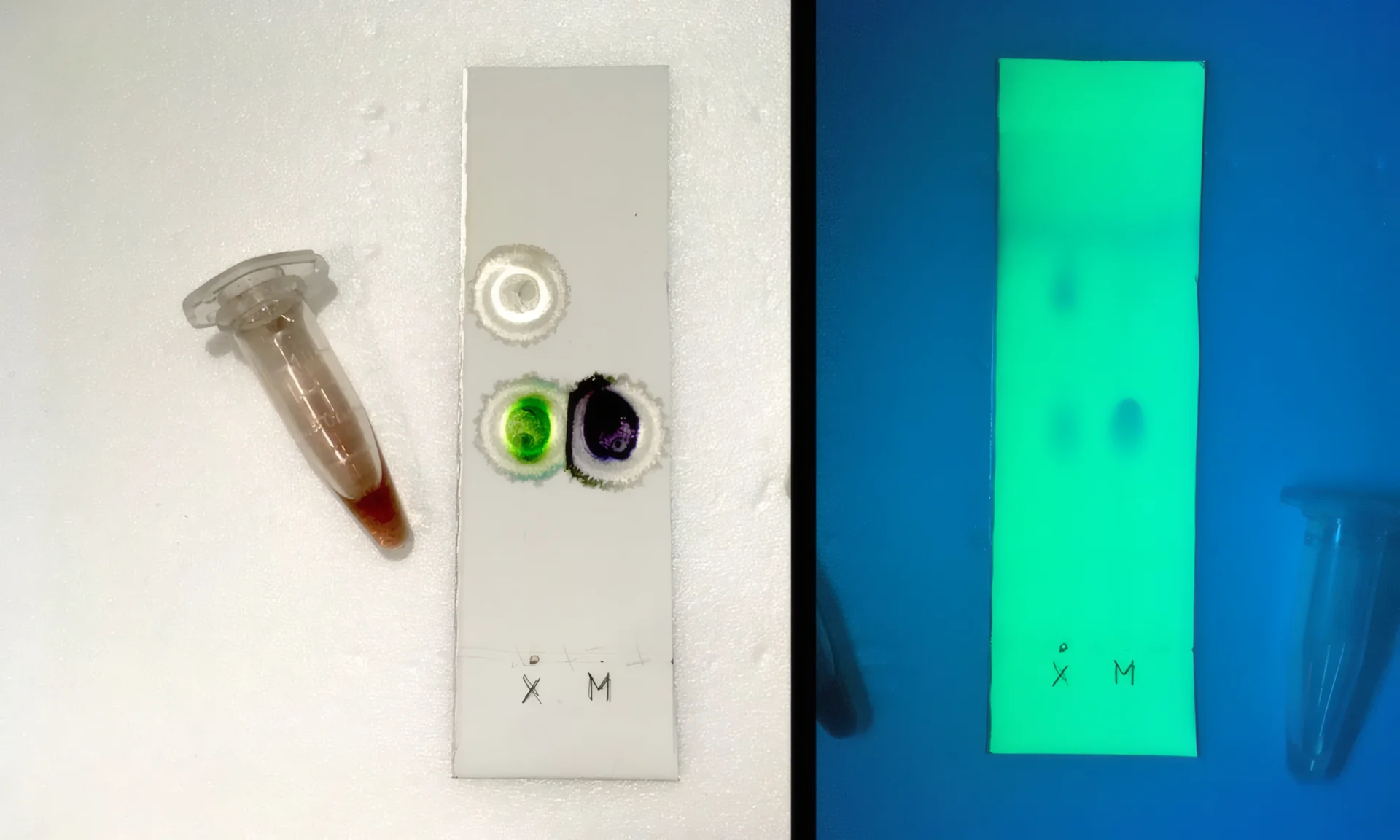
Thin layer chromatography (TLC) separates a sample into its individual components. A trace of the sample is placed on a coated card, the card stands in a shallow pool of solvent, and the solvent carries each compound up the card at a different speed. What you get is one spot per compound, and the position of each spot identifies it against a reference.
That is what makes TLC different from a reagent. A reagent gives you a single colour for the whole sample. TLC shows you how many things are in it, and by comparing spot intensity against a reference sample of known concentration, roughly how much of each.
Step by step
- Dissolve a measured amount of sample in the supplied liquid.
- Spot it onto the TLC card alongside the reference standard.
- Stand the card in the developing liquid and let the solvent rise.
- Read the card under UV light and compare the spots against the reference.
- Identify each spot using reagent tests. TLC separates compounds; it does not name them on its own.
Which purity test do I need?
- Full PRO Test Kit for Substance Purity — the broadest purity coverage, for people testing more than one kind of substance.
- MDMA purity and identification, cocaine, amphetamine, ketamine, mephedrone and methamphetamine — single-substance kits that answer both questions at once.
- PRO Test Kit for Stimulant Purity — for anyone testing several stimulants.
- Cannabinoid quantity and identification — for flower, hash and oils.
- Quantity tests — when you need a dose figure rather than a purity percentage, for example before dosing MDMA or cocaine.
After the test
- Optional: neutralise the used reagent with a spoonful of baking soda before rinsing. It protects both you and your plumbing.
- Wash the testing surface under running water.
Frequently asked questions
- Does a strong reagent colour mean high purity? No. Colour intensity is not a purity measurement. Reaction speed says nothing about quantity either.
- Can a purity test identify a substance on its own? No. TLC separates the sample into components; identifying each one still needs reagent tests or a laboratory.
- How accurate is TLC? It is a good estimate, not a laboratory figure. Where a free lab analysis service exists, use it.
- Do I still need reagents if I own a purity kit? Yes. The two answer different questions and are designed to be used together.
Where to buy a purity test
- Purity tests — use alongside reagents.
- TLC test kits — the reusable option.
- Full PRO Test for Substance Purity and Identification — both questions in one box.
- …or read What is the best drug test? and browse all available PRO Test kits.
Related guides
No test result can tell you a substance is safe. No substance is 100% safe.This article is published for harm reduction purposes. It does not encourage the use of psychoactive substances and does not replace medical advice.