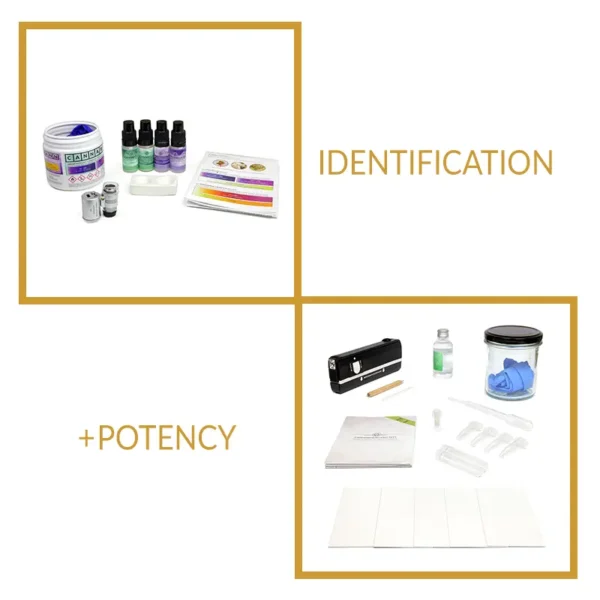
The best cannabis test kit is two tests. One tells you which cannabinoid the material is built on. The other tells you how much. Reagents answer the first in two minutes. A testing card gives you the full cannabinoid profile in about twenty.
That order matters here more than with any other substance. Cannabis and legal CBD hemp come off the same plant and look identical, so the question is almost never “is this cannabis” and almost always “which one is this, and how strong”.
Of 20,636 English lab records in our alerts database, 304 were handed in as cannabis, hash, CBD flower or a THC product. Of those, 117 held a synthetic cannabinoid and 135 listed no THC at all.
These are alerts, not the average street bag, and they are other people’s samples. They show what turns up on the market, and a test kit shows whether the flower, block or oil you are holding matches it.
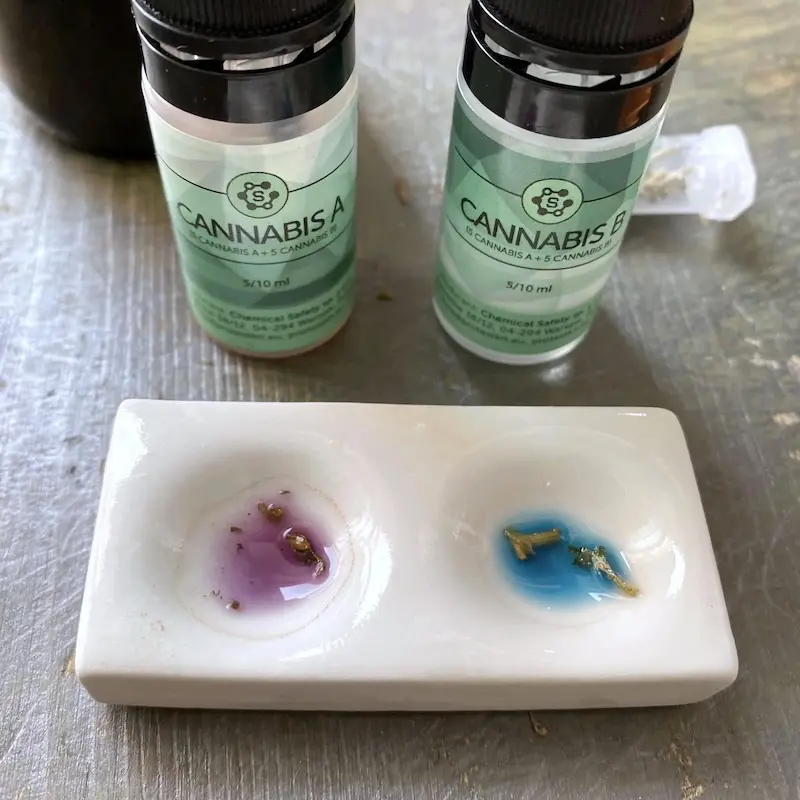
One reagent, two flowers. Purple is CBD-dominant, blue is THC-dominant.
Four colour tests are sold for this question, and they are not equivalent. Weakest first.
Look at it first
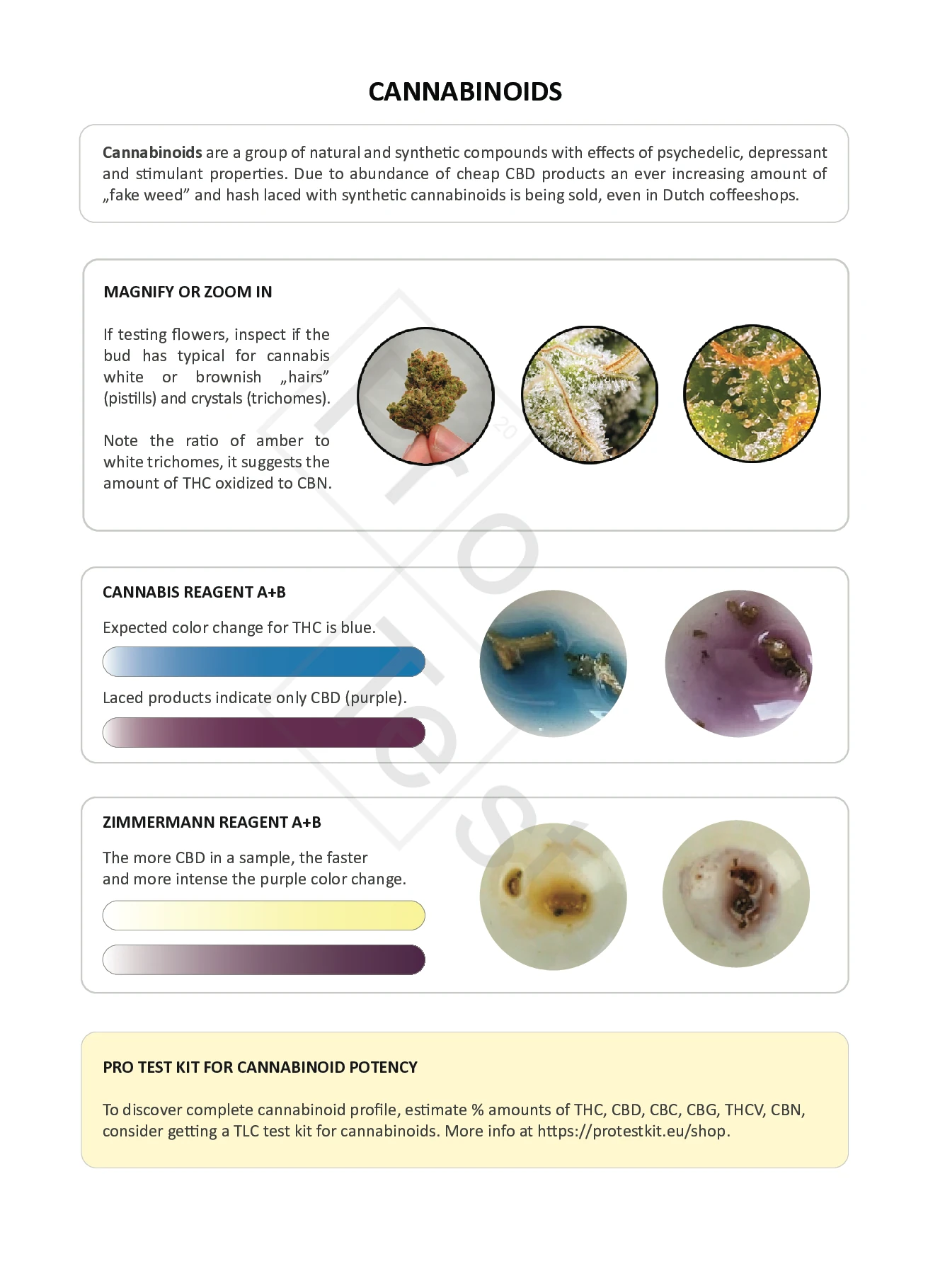
Cannabis flower carries pistils, the white or brown hairs, and trichomes, the resin heads. Amber trichomes instead of white ones mean THC has already turned to CBN, so the material will feel heavier.
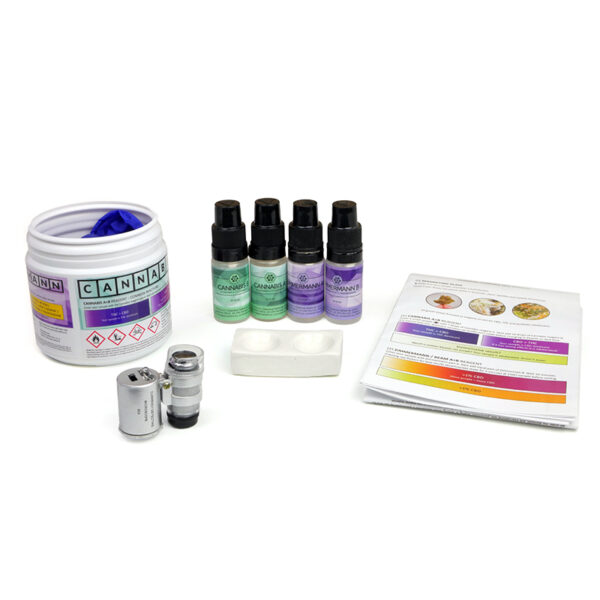
A magnifying glass comes with the multi-reagent kit. It says nothing about hash, oil, edibles or sprayed flower.
Duquenois-Levine
This is the roadside test. Other brands still sell it to the public, some with a colour card beside it that looks like a THC potency scale.
It is not one. The shade follows the ratio of THC to CBD, not the amount of either, so strong and weak material of the same make-up land on the same colour. Too much sample turns it purple.
It also reads positive on patchouli, spearmint, eucalyptus, nutmeg and tea, and in 2008 two travellers were held at Toronto airport because it called their raw chocolate hashish. It gives nothing with synthetic cannabinoids. We do not sell it.
Fast Blue BB, off the card
Fast Blue BB is the dye that makes cannabinoids show up in colour. It is sold on its own too, as a few drops on a raw sample with a chart beside it.
It colours every cannabinoid at once. THC comes out red, CBD and CBG orange, CBN pink to purple. On a sample holding all of them, CBD and CBN deepen the red that THC gives, so the reading comes out too high.
Separate the sample before the dye and each colour belongs to one compound again. The testing card does that, further down.
The Beam test
Beam dates to 1911. Add ethanolic potassium hydroxide and a deep purple develops.
The purple comes from a CBD oxidation product, so Beam answers for CBD, CBG and CBDA and gives nothing with THC. That made it a poor “is this cannabis” test and a precise CBD one.
Our Zimmermann reagent contains it. On cannabis it confirms roughly 1% CBD or more, and the faster and darker the purple, the more CBD. If the CBD content is low the colour can appear only as the spot dries, and that still counts.
Cannabis (4-AP)
The Cannabis reagent is built on 4-aminophenol, which is why the booklet calls it 4-AP. Two parts, A and B, and one job:
Blue means THC-dominant.
Pink or purple means CBD-dominant.
Here “dominant” has a number behind it. Forensic validation puts blue at about three times more THC than CBD, and pink at about three times more CBD than THC. Closer than that and the colour is inconclusive, so run the card.
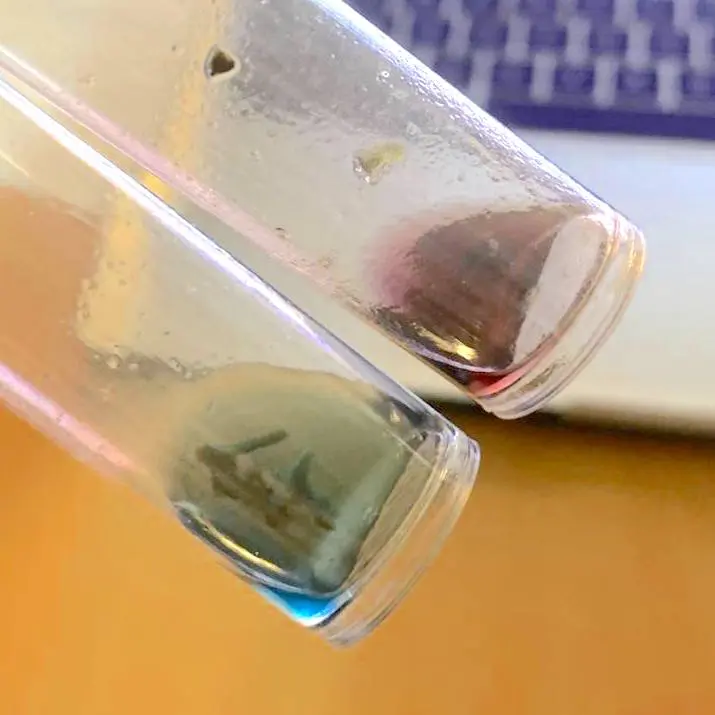
The same reagent in the single-use ampoule. Pink above, blue below.
Use a very small sample. The reaction is sensitive enough that too much gives a false negative, and the fix is less material plus another drop of part B. Its published false positives are short: sage, oregano, and a few single cannabinoids including CBN.
Run Beam beside it and you get both halves:
Blue on 4-AP, little on Beam: THC-dominant.
Purple on both: CBD-dominant, whatever the label said.
Purple on Beam from a block sold as hash: sprayed CBD resin, not hash.
The reference chart from the kit booklet. Tap to enlarge.
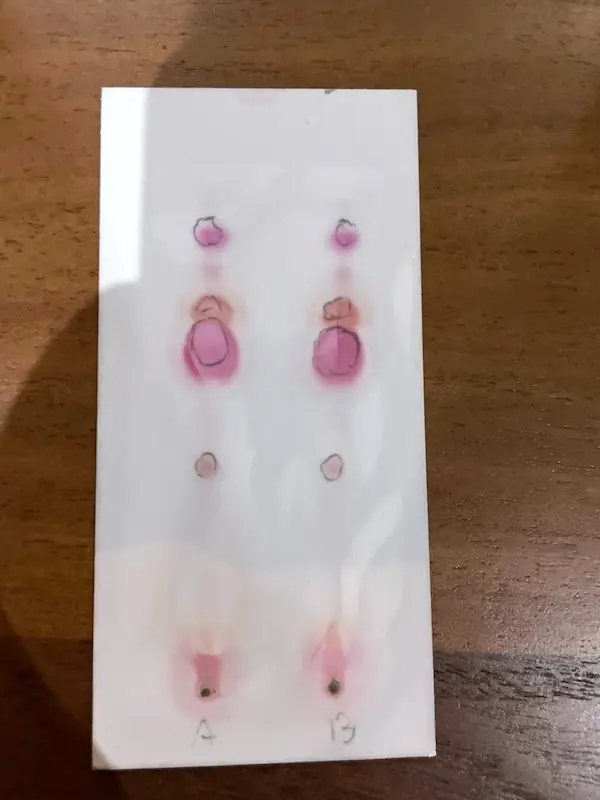
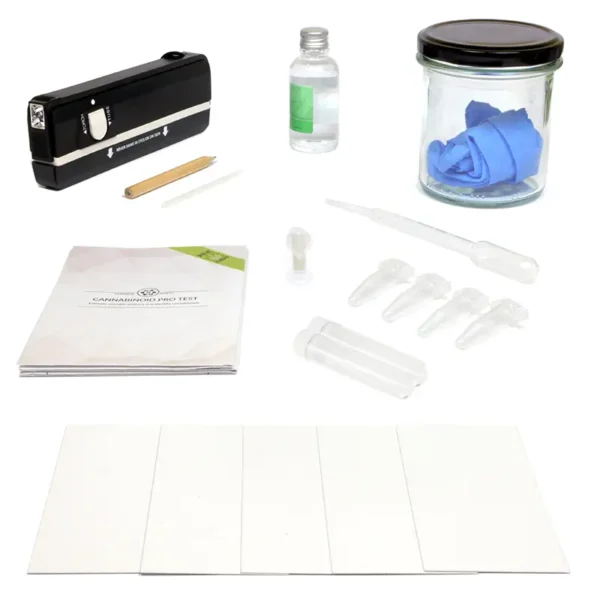
A cannabinoid testing card separates your sample into its parts, then puts a percentage on each one. THC, CBD, CBN, CBG, CBC and THCV each travel their own distance and end as their own spot, with the acid forms, THCA and CBDA, lowest of all. Three steps, about twenty minutes:
Prepare the sample. Weigh it, dissolve it in the testing liquid, apply it to the marked dot on the card.
Run the test. Stand the card in the jar and wait while the cannabinoids separate into spots.
Read the result. Reveal the spots with the UV-C light, then compare them with the reference chart or let the app do it.
How much you weigh out sets the range, so the same card reads from nought to 100%. Flower and hash go in the middle band, THC oil and extracts in the top one. The answer lands within about ten percentage points.
Two failures, both fixed by one repeat. One merged smear means too much sample: go a band down. A flame-shaped streak along the bottom means the material was not decarboxylated: heat it and run it again.
Two samples, one card. Every cannabinoid lands in its own place, so the profiles compare directly.
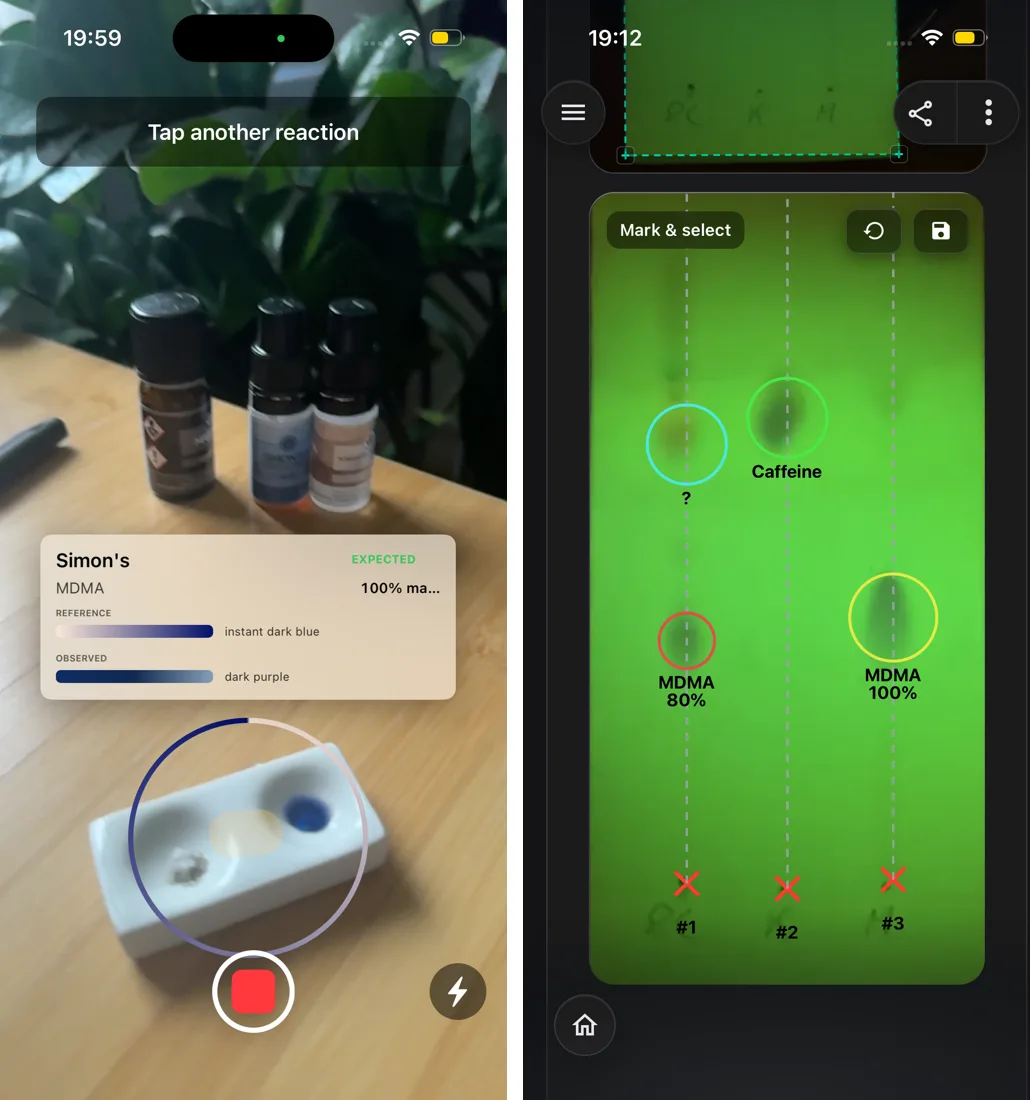
Room light, camera and angle all shift the colour you see, and the 4-AP purple that means CBD is a short step from the blue that means THC. The DrugsPRO app corrects for that. Point it at a reaction and it matches the colour against references shot in several kinds of light. Point it at a card, drag the four corners, and it measures every spot and turns the lengths into percentages. It runs on your phone and uploads nothing.
Matching a reagent reaction, left, and measuring spots on a straightened card, right.
The cannabinoid dye is the Fast Blue BB from earlier, used the way it works. Dip the finished card and the spots come out in daylight: CBD, CBDA and CBG orange, THC red to pink, CBN pink to purple, THCA pale purple.
Nothing stacks, because the compounds are already separated. Each colour belongs to one spot, so the card now names them as well as counts them.
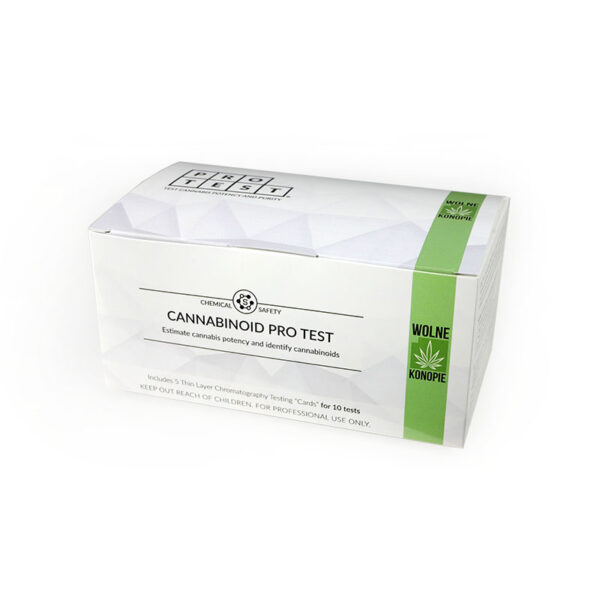
€4,65–€6,97Price range: €4,65 through €6,97Select options
This product has multiple variants. The options may be chosen on the product page
Not every chart is your chart
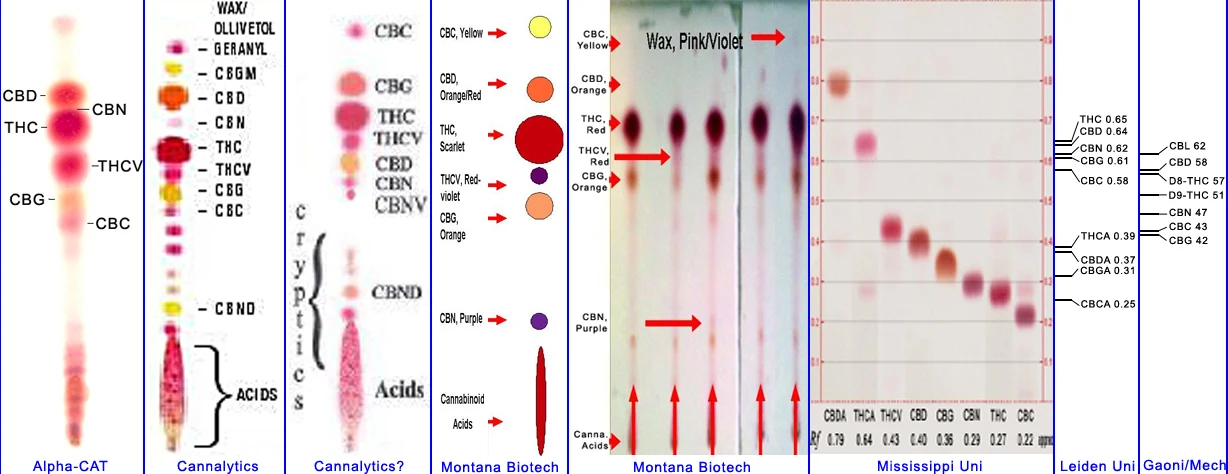
Published cannabinoid reference charts do not agree with each other, because the order of the spots depends on the solvent and the card, not on the cannabinoids. Below: eight of them side by side, then four compared on where they put THC, CBD and the acid forms.
Eight published cannabinoid references. Same compounds, no two orders alike. Tap to enlarge.
Four cannabinoid separation systems and where they put the same compounds
System
Runs higher
Acid forms
Our testing card
CBD, THC just below
lowest on the card
Gaoni and Mechoulam
CBD, THC below
not listed
Mississippi group
CBD, THC well below
at the very top
Leiden group
THC, by one hundredth
below the neutrals
Two of those will ruin a reading. Leiden swaps THC and CBD and puts them a hundredth apart. Mississippi finishes the acid forms at the top of the card instead of the bottom.
So use the reference chart that came with your kit. On our cards THC sits directly below CBD, and mixing up that pair is the commonest reading error there is.
Watching it change
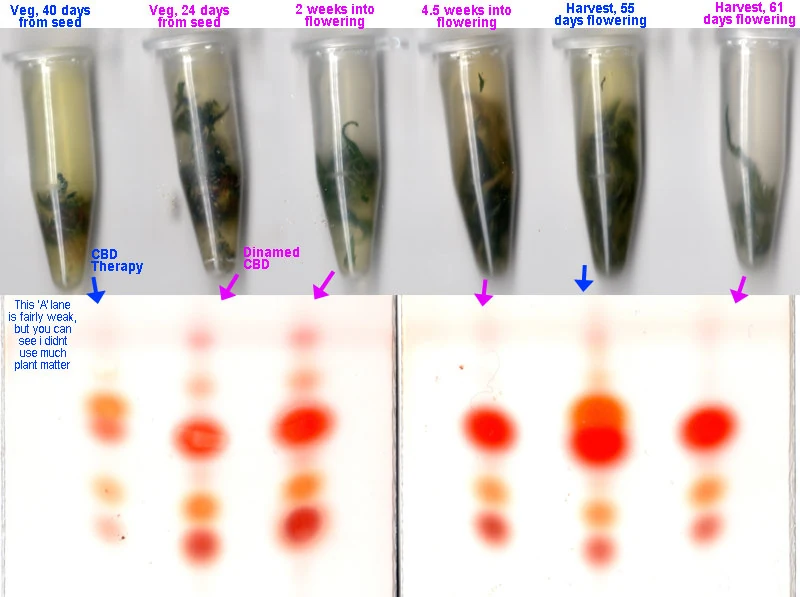
Run a lane at each stage and the card shows a curve instead of a number: spots fill out as the plant matures, the acid band shifts as the material dries and cures, CBN appears as THC oxidises. The same works on this week’s batch against last month’s, or hash before and after a year in a drawer.
Two CBD-rich plants from vegetative growth to harvest, one lane each. The grower notes the first lane is faint because they loaded little plant matter. Tap to enlarge.
The blank that matters
Synthetic cannabinoids are not cannabinoids, so no cannabis test colours them. You see an absence instead.
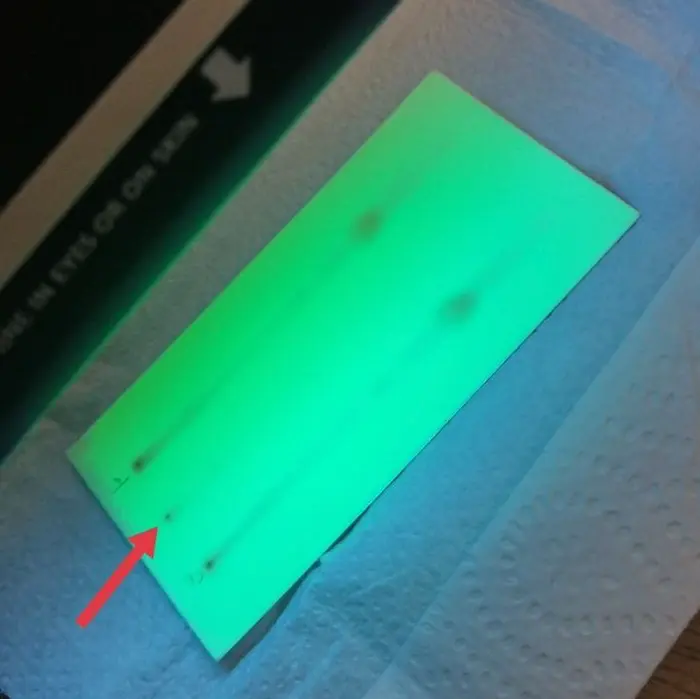
Plant material that should be strong but gives no blue on 4-AP, or shows only a trace of THC on a card, has something else doing the work. Nothing else you can do at home signals a sprayed product as reliably, and it costs one drop.
A sample sold as cannabis, under UV-C. Almost nothing ran, and on strong material that emptiness is the result.
€4,65–€6,97Price range: €4,65 through €6,97Select options
This product has multiple variants. The options may be chosen on the product page
Which cannabis test kit is the best: common questions
Can a reagent tell me the THC percentage?
No. 4-AP tells you which cannabinoid dominates, Beam tells you roughly how much CBD. A percentage needs the card or a lab.
What about kits that claim a percentage from a colour?
Check what the colour tracks. Duquenois-Levine follows the THC to CBD ratio, not the amount. A raw Fast Blue BB reading adds every cannabinoid together. Neither gives a percentage.
What if 4-AP gives no colour?
On material that should be strong, usually very little cannabinoid, which points at a sprayed synthetic. It can also be too much sample, so repeat with less and an extra drop of part B first.
Does this work on hash and THC oil?
Yes. Hash needs far less material than flower, oils and extracts go in the top band. For a finished edible, test the oil before it goes in the tray: see how many milligrams is that gummy really.
Can I test THCA?
On a card, yes, the acid forms show as their own spots low down. On a reagent, no. If the acids dominate, the material has not been decarboxylated.
One kit only?
The cannabinoids and cuts kit. Both reagents, two minutes. Add the card when you want the number.
No test result can tell you a substance is safe. No substance is 100% safe.This article is published for harm reduction purposes. It does not encourage the use of psychoactive substances and does not replace medical advice.